

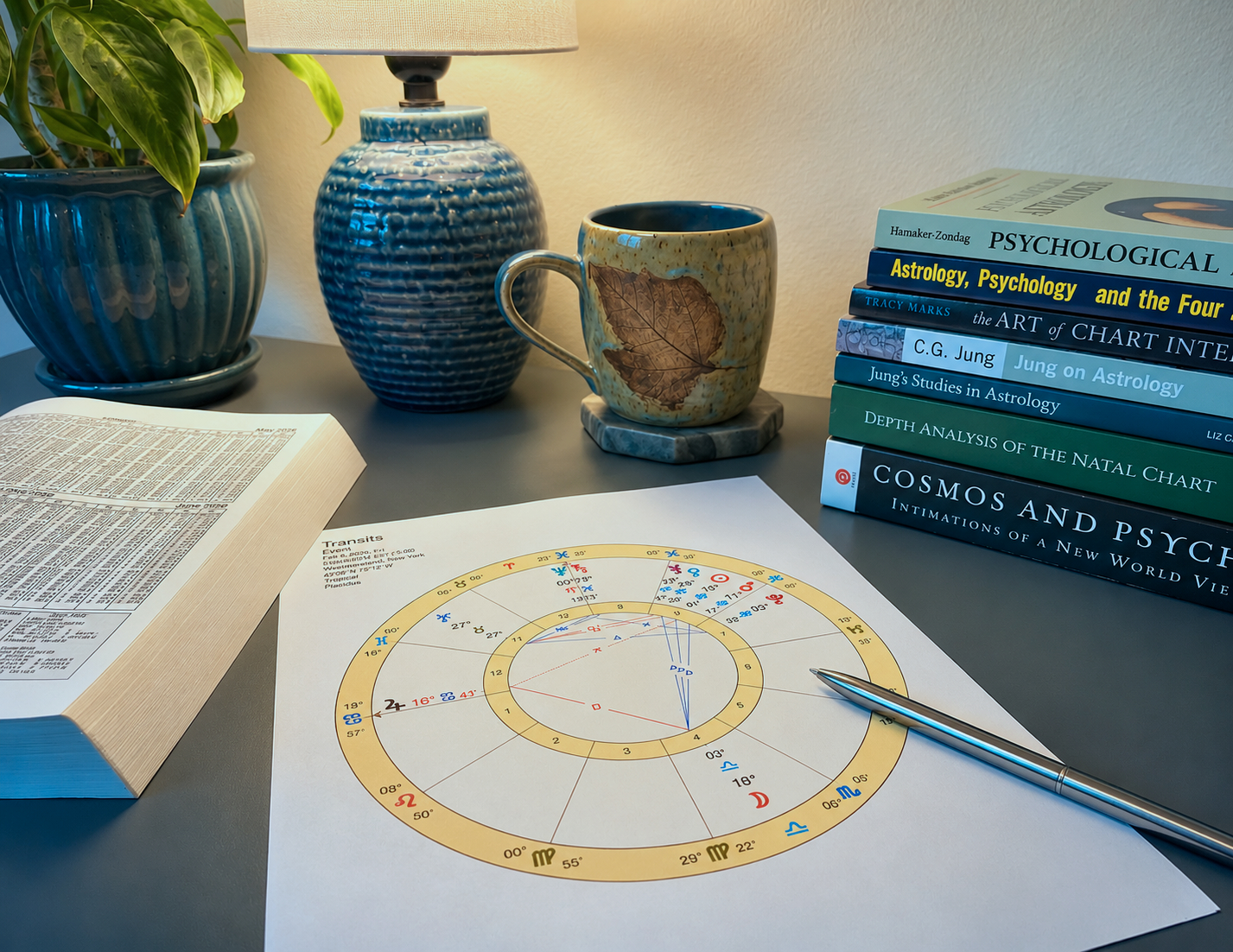

Astrology-Informed Psychotherapy
Enrich your therapy with fresh perspectives drawn from the timeless symbolism of astrology.
For patients who are curious about astrology, I offer the opportunity to work with a psychotherapist who is also a practicing astrologer. Drawing upon the tradition of psychological astrology, I use natal charts and planetary transits as symbolic frameworks for exploring the complexities of psychological life.
My approach to psychotherapy remains fundamentally relational and psychodynamic, emphasizing unconscious beliefs, inner conflicts, longstanding patterns of experience, and the therapeutic relationship itself. Astrology complements this work as an additional interpretive resource, not as a substitute for the careful, collaborative process of psychological understanding.
With your interest and consent, I may familiarize myself with your natal chart and examine relevant planetary transits. Astrology generally informs my thinking in the background rather than becoming an explicit subject of our conversations, although we may explore particular symbols or interpretations together when doing so seems therapeutically meaningful.

My Approach to Astrology
My approach belongs to a tradition of psychological astrology that draws upon the work of Carl Gustav Jung and subsequent generations of astrologers and thinkers who have explored the relationship between astrological symbolism and psychological life. Among those who have influenced my understanding are Stephen Arroyo, Liz Greene, Howard Sasportas, Karen Hamaker-Zondag, Richard Tarnas, and Kieron Le Grice.
The single most important influence on my approach, however, is psychologist and astrologer Glenn Perry, whose model of Astro-Psychology integrates astrological symbolism with theories of human motivation, personality, and psychological development.
Building upon this foundation, I understand zodiacal signs as symbols of fundamental psychological needs and motivations; the planets as psychological functions through which the fulfillment of those needs is pursued; the houses as the experiential theaters in which these activities unfold; and planetary aspects as representations of beliefs and expectations concerning the perceived likelihood of satisfying psychological needs.
My approach is psychodynamic rather than trait-based. Instead of assigning fixed personality characteristics to astrological placements, I seek to understand the psychological needs that motivate particular activities, the circumstances that orient their expression, and the beliefs that may facilitate or inhibit their satisfaction.

My approach also involves returning to the first principles of astrological symbolism to derive coherent, differentiated psychological meanings, rather than relying upon inherited collections of descriptive keywords.
Consider Scorpio, traditionally associated with emotional intensity, eroticism, secrecy, jealousy, power, psychological depth, crisis, and transformation. At first glance, these associations may appear to constitute a loosely connected assortment of personality traits, behaviors, and experiences. Yet when we return to the sign’s underlying astrological principles, a more coherent psychological meaning begins to emerge.
Scorpio is the fixed water sign, found in the zodiac’s interpersonal phase, which spans the signs of Leo, Virgo, Libra, and Scorpio. Elemental water signifies emotional experience; the fixed modality signifies persistence and continuity; and the interpersonal phase concerns relationships between differentiated individuals. Together, these principles suggest a fundamental psychological orientation toward sustained emotional presence amid the potentially disruptive experiences of intimacy.
From this perspective, Scorpio's familiar associations become intelligible as possible expressions or consequences of a common underlying principle. Psychological transformation, for example, may arise through sustained engagement with emotionally demanding and disruptive experiences, but it is not the sign's intrinsic objective. The same principle may just as readily find expression in stoicism, forbearance, and other forms of steadfast emotional endurance.
The purpose of this method is not merely to reinterpret familiar astrological meanings, but to understand why those meanings belong together in the first place.

A similar commitment to psychological differentiation informs my interpretation of planetary placements.
For example, Mercury in Taurus is sometimes characterized as indicating a slow or stubborn mind. From my perspective, this interpretation appears to result from a rather reductive and mechanical combination of inherited symbolic associations: Mercury signifies thinking, Taurus is associated with slowness and stubbornness, and the two are simply joined together to produce a description of cognitive style. Such an approach mistakes the juxtaposition of descriptive keywords for a psychologically coherent synthesis of astrological principles.
In my approach, Mercury represents the psychological function of local cognition: curiosity, inquiry, observation, comparison, classification, communication, and the flexible manipulation of mental representations. Taurus, meanwhile, symbolizes the need to establish and preserve material security, physical stability, and the comforts and pleasures of embodied existence.
Mercury in Taurus therefore suggests that the acquisition, differentiation, organization, and exchange of information become especially compelling, meaningful, or gratifying insofar as they may contribute to material security, the preservation and enjoyment of physical resources, and the cultivation of comfortable or pleasurable embodied existence. This might find expression in an interest in practical knowledge, the comparison and classification of material goods, or the exchange of information that enhances everyday comfort and security.
None of this establishes anything about the individual's intelligence, processing speed, or cognitive abilities. The placement concerns the motivational organization and directionality of mental activity, not its speed, sophistication, or effectiveness.

Alongside natal chart synthesis, I give equal attention to planetary transits, which provide a symbolic perspective on psychological development through time. Whereas the natal chart suggests enduring psychological needs, tensions, capacities, and developmental possibilities, transits invite consideration of how particular dimensions of psychological life may temporarily assume greater prominence during specific periods.
From this perspective, planetary transits may symbolize the temporary developmental ascendance of particular archetypal dynamics. Psychological needs, conflicts, and capacities that ordinarily remain in the background may become more salient, pressing for conscious recognition, expression, or integration. A transit may thus suggest a period in which certain psychological functions are especially engaged, longstanding beliefs are challenged, or previously neglected dimensions of the personality seek fuller expression. These periods may be experienced as opportunities for growth, sources of tension, or both, depending upon the individual's psychological organization and circumstances.
My interest is not in using astrology to determine who someone is or what will happen to them. Rather, I am interested in how natal chart synthesis and transit evaluation can introduce questions and perspectives that might otherwise remain unexplored. Because their astronomical configurations are calculated independently of the patient’s conscious self-understanding and the therapist’s interpretive assumptions, they offer an additional symbolic point of reference from which familiar experiences may be reconsidered. Their psychological interpretations remain possibilities for reflection rather than established truths, always considered in relation to the patient's lived experience and the understanding that develops through psychotherapy.
How is astrology incorporated into psychotherapy?
Astrology is entirely optional. With your permission, I may study your natal chart and relevant planetary transits alongside the understanding of your psychological life that develops through our conversations.
Our work remains centered on your experience, relationships, concerns, and therapeutic goals. Astrology is a supplementary interpretive resource, not a separate treatment or substitute for psychotherapy.
Will we discuss my natal chart during sessions?
Not necessarily. Astrology usually informs my thinking in the background, and we may rarely discuss it explicitly.
If an astrologically inspired observation seems relevant, I may introduce it as a question or hypothesis for us to explore together. I do not offer separate astrological consultations through my psychotherapy practice.
What information would you need?
Your date, exact time, and place of birth. I use Astro Gold software to calculate natal charts and planetary transits, and store birth information and chart data locally on an encrypted hard drive.
Providing this information is voluntary.
Do I need to believe in astrology?
No. Curiosity is sufficient, and skepticism is welcome. Astrology can be approached as a symbolic tradition whose interpretations offer possibilities for psychological reflection without requiring any particular metaphysical belief.
Can I combine astrology-informed psychotherapy with Tarot-assisted psychotherapy?
Absolutely. Astrology and Tarot offer complementary symbolic frameworks for exploring psychological experience. While natal charts and planetary transits provide perspectives on enduring psychological needs, inner conflicts, and developmental themes, Tarot offers a more immediate, interactive means of exploring personal experience through imagery and reflection.
Both approaches can be incorporated into our work together according to your interests and therapeutic needs. Because Tarot-assisted psychotherapy is currently offered exclusively in person, combining the two approaches requires in-person sessions.
Curious About Astrology-Informed Psychotherapy?
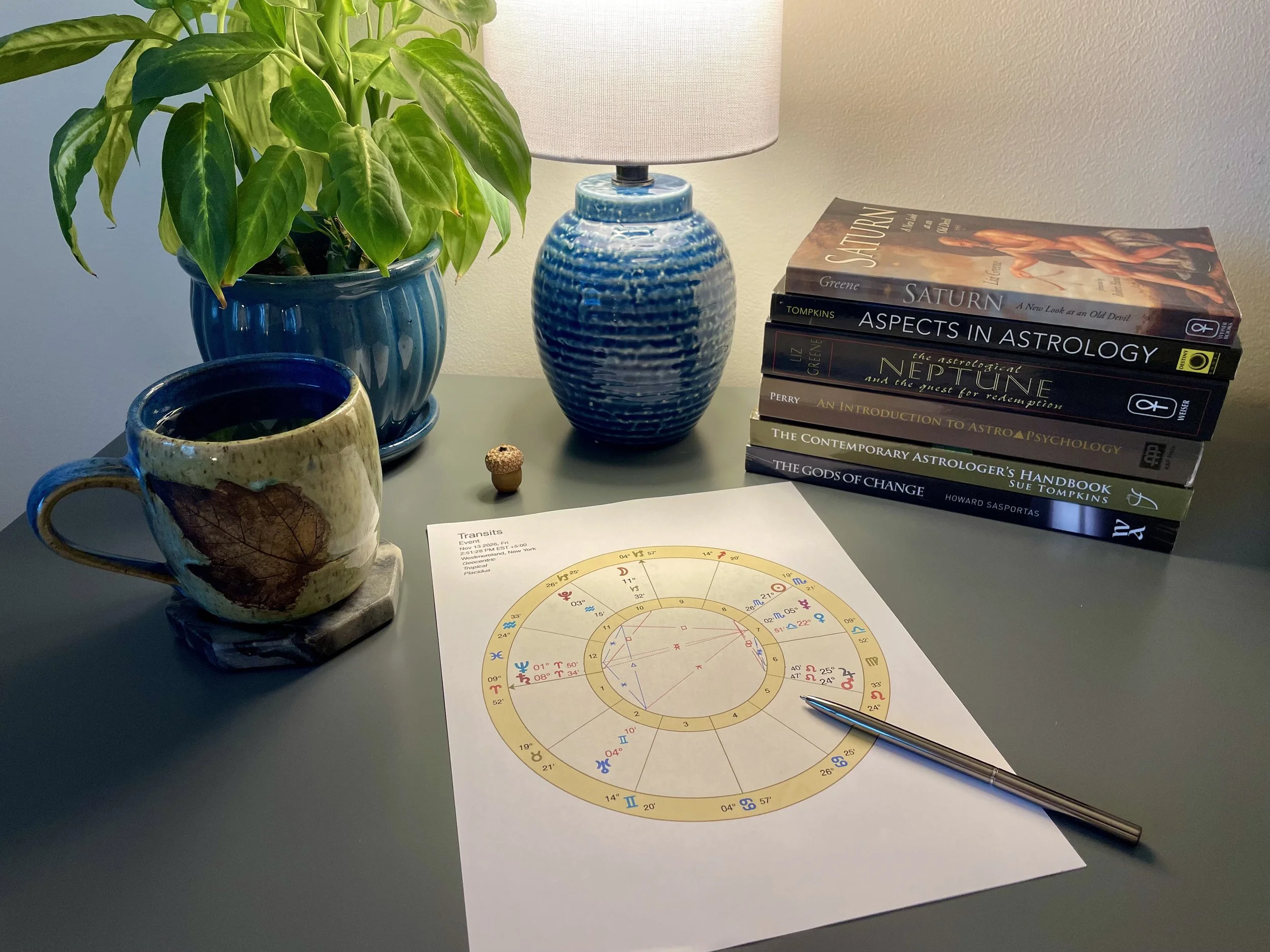
If you're interested in exploring your psychological life through a depth-oriented approach that welcomes astrological symbolism, I invite you to schedule a complimentary 15-minute phone consultation. We'll have an opportunity to discuss what brings you to therapy, answer any questions you may have, and consider whether working together might be a good fit.