

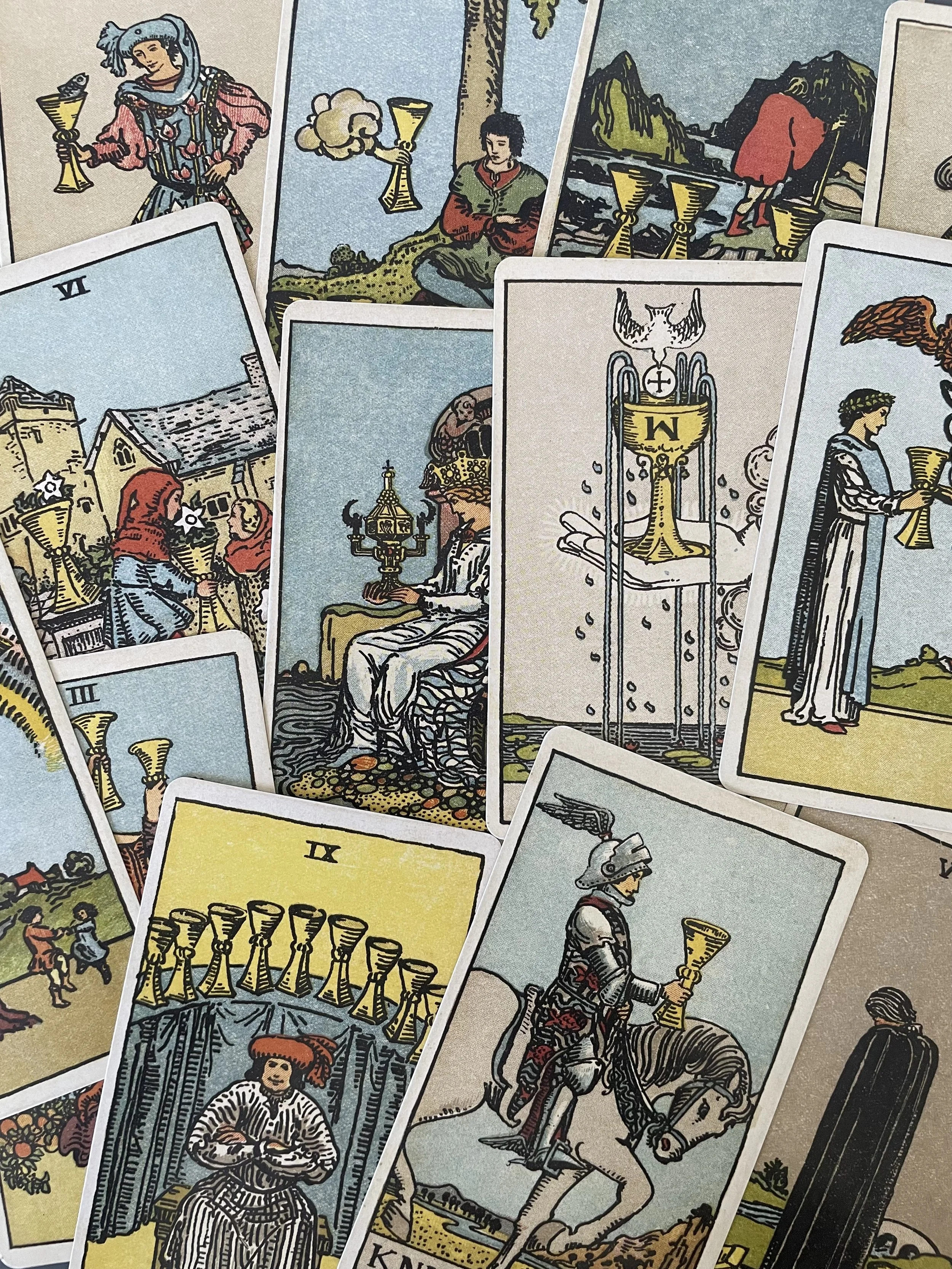
Tarot-Assisted Psychotherapy
Sometimes, we understand ourselves differently when we encounter our lives in images rather than explanations.
For patients who are interested, I offer the option of incorporating Tarot into psychotherapy as a symbolic and projective medium for psychological exploration. Tarot's rich imagery provides another way of approaching the experiences, relationships, conflicts, and questions already alive in our therapeutic work.
Tarot is used neither predictively nor prescriptively. The cards do not tell us what will happen, what you should do, or what decisions you should make. Nor do they replace psychotherapy, clinical judgment, or your own capacity to determine the course of your life.
Instead, Tarot offers another language through which we can explore psychological experience: a language of images, symbols, associations, and possibilities.
Why Tarot in psychotherapy?
Much of our psychological life unfolds through patterns of perception, feeling, and interpretation that are so familiar to us that we may scarcely recognize them as patterns at all. We come to understand ourselves, other people, and our circumstances in characteristic ways, often shaped by experiences and expectations that lie partly outside conscious awareness.
Tarot offers an unusual opportunity to encounter these patterns through imagery.
When we contemplate a Tarot card, we do more than observe a picture. We bring our own memories, feelings, needs, fears, hopes, and associations to what we see. The psychological processes involved in this encounter—including apperception, projection, and externalization—can allow aspects of our inner experience to find expression in the meanings we perceive and the stories we construct.
But Tarot may do more than reflect what we already bring to it.
From a Jungian perspective, Tarot's imagery also draws upon archetypal patterns: recognizable characters, situations, conflicts, and passages of human experience that reach beyond the circumstances of any one individual. These symbolic possibilities may introduce something unfamiliar into our established ways of understanding ourselves.
An image may challenge an assumption, evoke a neglected feeling, illuminate a conflict, or suggest a psychological position we have not yet considered. Sometimes, the most interesting thing about a card is precisely the way it does not fit our accustomed understanding of a situation.
In this sense, Tarot can provide both a mirror for psychological experience and an invitation to move beyond familiar ways of perceiving and interpreting it.
If you're curious about what Tarot-assisted psychotherapy might look like in practice, I invite you to explore the questions and answers below. They offer a closer look at the psychological ideas behind this approach, how we might use the cards together, and the principles that guide their use in therapy.
When does Tarot enter the therapy?
Not immediately.
Before introducing Tarot, I believe it is important for us to have had time to establish a therapeutic relationship and develop some understanding of the difficulties that brought you to therapy.
You should have an opportunity to tell your story, describe your concerns in your own words, and explore them through the ordinary means of relational psychodynamic psychotherapy: conversation, reflection, association, curiosity, and attention to what unfolds between us.
Only after this foundation has begun to develop might we consider whether Tarot could contribute something useful to the work.
This matters because Tarot is not intended to replace your own account of an experience or provide a shortcut around the slower work of coming to know one another. The cards enter an already developing therapeutic conversation, where they may deepen, complicate, or introduce new perspectives on material we have begun exploring together.
Talk therapy remains the foundation. Tarot, when used, enters in service of it.
How might we use Tarot in a session?
There are two principal ways we might incorporate Tarot into our work.
Contemplation and Amplification
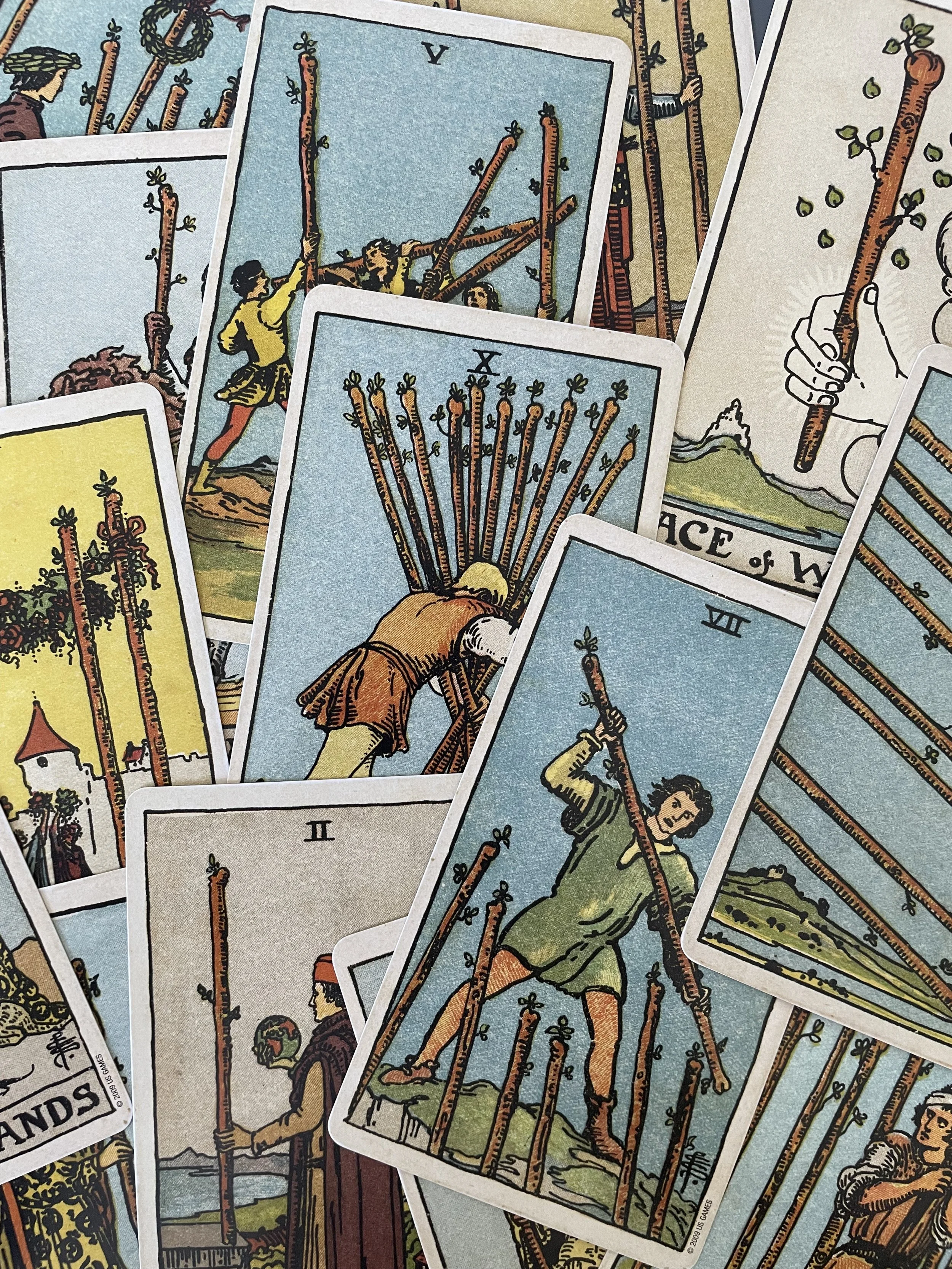
Sometimes, I may invite you to look through the deck, with the cards face up, and choose an image or set of images that seems to capture something about an experience, relationship, conflict, or feeling we are exploring.
Together, we can attend closely to the image: what attracts or repels you, what you identify with, what surprises you, and what memories, feelings, or associations emerge.
We might also explore the image through storytelling, imagining what has brought its characters to the situation depicted, what they might be thinking or feeling, and what could happen next. The stories we construct around an image may reveal something about our characteristic ways of understanding ourselves, other people, and the possibilities available to us.
We may also explore the card's traditional symbolism and its possible archetypal meanings, considering how these might enrich or challenge your initial response.
In this way, the image can give visible form to something that may have been difficult to articulate, while also introducing possibilities that extend beyond what you initially recognized in it.
Interpretation of Tarot Spreads
At other times, we may use a small, lightly structured Tarot spread organized around a particular question or area of exploration.
You or I may draw the cards at random, without knowing which images will appear.
This introduces an element of unpredictability—what we might call creative chaos—into the therapeutic conversation. Because neither of us deliberately chooses the resulting images, we may encounter perspectives, associations, or symbolic possibilities that would not otherwise have occurred to us.
Importantly, Tarot's imagery is not random in its psychological subject matter. Its symbolic repertoire encompasses a wide range of recognizable human experiences, conflicts, relationships, and developmental possibilities. Consequently, even an unexpected image may offer something relevant to the psychological question we are exploring.
That relevance need not be immediately obvious. It may emerge through our associations, interpretations, disagreements, or efforts to understand why a particular image seems so strangely appropriate—or inappropriate—to the matter at hand.
These two approaches allow us to work with Tarot in complementary ways: sometimes by finding an image for something you already sense, and sometimes by encountering an image you did not choose and discovering what it brings forth.
Who decides when we use Tarot?
Tarot is an invitation, never a requirement.
Either of us may suggest bringing the cards into the conversation. You might feel that Tarot could offer another way of approaching something we have been discussing, or I might recognize a moment when symbolic exploration could be useful.
In either case, we use Tarot only when we agree that doing so feels appropriate.
Choosing Tarot-assisted psychotherapy does not mean consenting in advance to the use of Tarot in every session—or even in most sessions. You are always free to decline an invitation to use the cards, and ordinary therapeutic conversation remains the foundation of our work.
Likewise, there may be times when you would like to use Tarot and I suggest that we remain with the conversation instead. Part of using Tarot responsibly in psychotherapy is attending to the role it is playing in the therapeutic process.
The cards should help us encounter uncertainty, complexity, and possibility—not become a means of avoiding uncertainty, seeking repeated reassurance, or surrendering difficult decisions to an outside authority.
Who interprets the cards?
We do.
Although I bring familiarity with Tarot's traditional symbolism, archetypal patterns, and psychological possibilities to our conversation, I do not occupy the role of an expert diviner who tells you what a card means or what it says you should do.
Your own responses to the imagery are indispensable.
Something I regard as hopeful may strike you as frightening. A detail that seems incidental to me may immediately capture your attention. A card may evoke a memory, provoke an unexpected feeling, or produce an association neither of us could have anticipated.
Those responses are not obstacles to finding the "correct" interpretation. They are part of what we are interested in.
At the same time, our exploration need not stop with your first impressions. We may consider other meanings suggested by the imagery, including those that challenge your initial interpretation or introduce unfamiliar psychological possibilities.
Interpretation therefore becomes collaborative: a conversation among you, me, the image, and the circumstances that brought us to it.
The purpose is not to discover what the cards have decided about your life, but to discover what becomes thinkable, feelable, or speakable through our encounter with them.
What about synchronicity?
Sometimes, a randomly drawn Tarot card seems so remarkably suited to the question or circumstance under consideration that its appearance feels uncanny.
Carl Jung used the term synchronicity to describe meaningful correspondences between psychological experience and external events that cannot readily be explained through ordinary causal relationships.
I remain open to the possibility that some encounters with Tarot may be understood in this way. But I do not claim to know definitively why such correspondences seem to occur, nor do you need to share my openness to synchronicity—or any particular spiritual or metaphysical belief—for us to work productively with the cards.
There are also more naturalistic ways of understanding Tarot's usefulness. The introduction of unexpected yet psychologically relevant imagery can disrupt habitual patterns of thought, stimulate new associations, and invite us to consider familiar problems from unfamiliar perspectives.
We do not need to settle the question of why a particular image appears in order to explore what happens when it does.
Is Tarot-assisted psychotherapy right for me?
You may find this approach especially appealing if you are drawn to imagery, symbolism, dreams, mythology, spirituality, creativity, depth psychology, or other ways of exploring psychological life that reach beyond purely literal or analytical conversation.
You may also simply be curious about what happens when an unexpected image enters a familiar problem.
No prior knowledge of Tarot is necessary. You do not need to identify as spiritual, believe that Tarot possesses supernatural powers, or subscribe to Jungian psychology.
Skepticism and curiosity are both welcome.
Tarot is not a separate treatment that replaces psychotherapy. It is an optional means of enriching the relational psychodynamic work we undertake together—one that may help us recognize established psychological patterns, encounter unfamiliar possibilities, and discover new ways of understanding ourselves and our circumstances.
Interested in Learning More?
For a deeper exploration of Tarot's history, its relationship to psychological theory, and its potential applications in psychotherapy, I invite you to read my introductory essay, Tarot-Assisted Psychotherapy: A Theoretical Synthesis and an Illustrative Three-Card Spread.
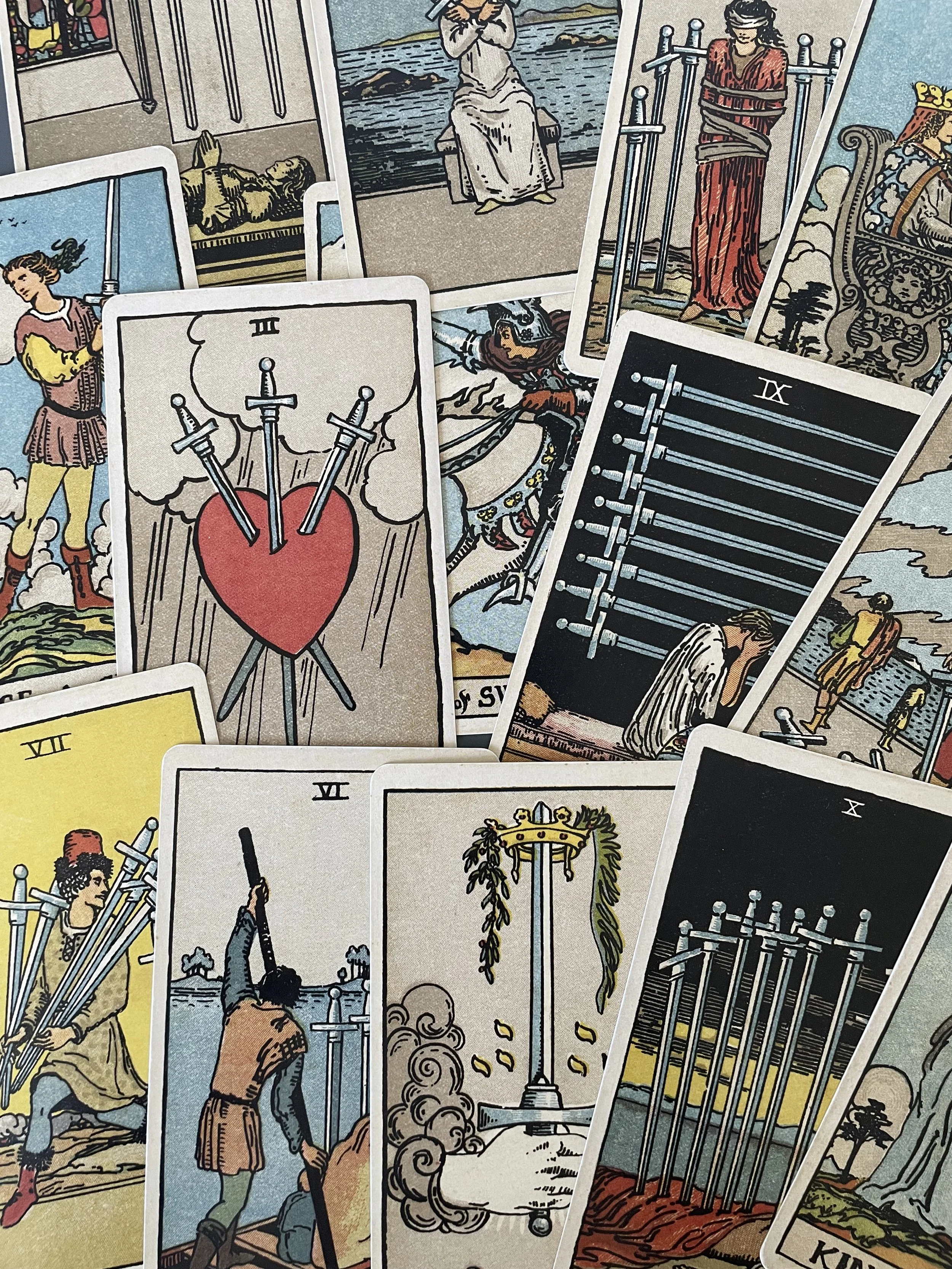
In addition to examining the historical and psychological ideas that inform my approach, the essay includes a firsthand account of a Tarot reading I conducted for myself, illustrating how traditional symbolism, personal associations, and unexpected perspectives can come together to facilitate psychological exploration.